Hardware
Reference wrist device
A development platform that captures inertial motion, surface electromyography, and contact pressure from the same wrist, in one form factor.

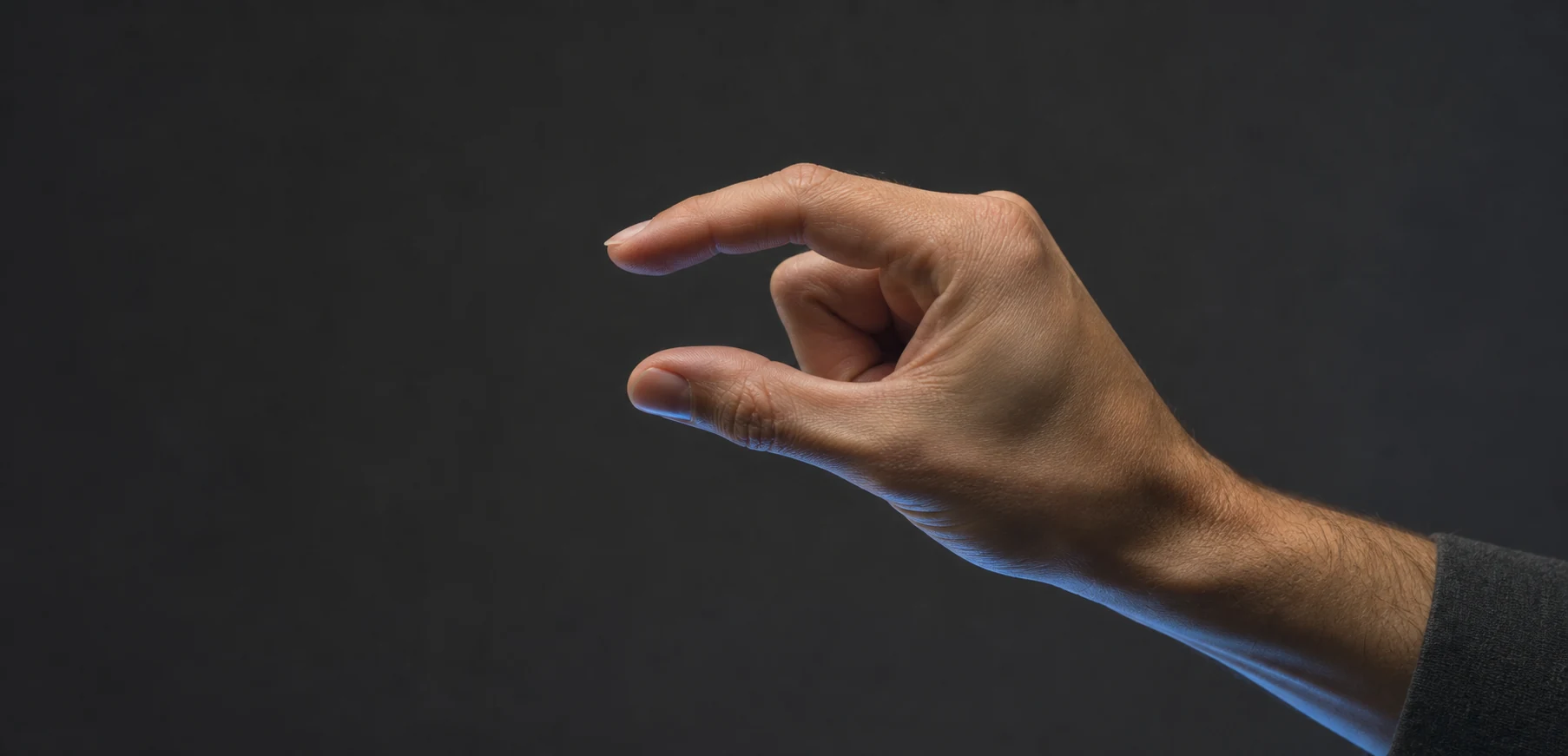
Wearable interface technology
Suhwa combines multimodal wrist sensing with intent-decoding software to help product teams prototype subtle, voice-free commands.
Reference wrist device Intent software Integration tools
Suhwa is a software company. The long-term product is the intent-decoding stack that turns wrist signals into reliable commands — and the integration layer that carries them into a partner’s device. We build hardware because the sensing we need does not exist off the shelf yet.
Not every moment is a voice moment. Wrist input is a complementary option for moments when quiet, deliberate control matters.
Hardware
A development platform that captures inertial motion, surface electromyography, and contact pressure from the same wrist, in one form factor.
Software
Software that interprets captured patterns against the compact command vocabulary defined for a product workflow.
Integration
An integration layer for passing the interpreted command into the connected product experience being explored.
Why we build the hardware
Commercial wristbands and smartwatches sense one or two of these well. Few, if any, bring all three together in a single wrist-worn form factor — which is what a compact, dependable command vocabulary needs. So we build the sensing ourselves, tightly coupled to the decoding stack, and use it to run early pilots.
Representative command primitives
Examples under development · defined per workflow
Suhwa starts with an intentional product action, then works backward to the movement, sensing, and interpretation needed to support it.
MoveThe user makes a subtle, intentional gesture.
SenseThe reference device observes EMG and motion at the wrist.
InterpretSoftware maps the captured pattern to the intended command.
IntegrateThe command enters the defined product workflow.
Reference system in active prototype development.
For product teams building AI glasses and next-generation wearables
A focused design partnership turns an abstract interaction question into something a team can examine in context.
Explore a design partnershipSuhwa is software-first by design. Hardware is how we get the interaction proven; software and IP are what we intend to sell.
Now
Next
At scale
Current stage: design-partner discovery. The aim is focused learning, not a one-size-fits-all gesture program.

Suhwa, Inc. · Austin, Texas
Suhwa is bringing wearable-sensing and human-machine-interface research toward a product system for AI glasses and next-generation wearable devices.
Technical problem owner and lead researcher
Heeyong is a UT Austin PhD graduate whose research sits exactly where this product does: brain–computer interfaces, human–machine interfaces, and human–robot interaction. The work has been hardware and software together — building the wearable sensing, then building the processing that makes its signals usable.
That is the same problem Suhwa is solving commercially, which is why the company builds its own sensing rather than waiting for the market to supply it.
Peer-reviewed work
Selected publications, first-authored, on the wearable EMG sensing and signal processing the product is built on.
IEEE Transactions on Neural Systems and Rehabilitation Engineering 2026
Vol. 34, pp. 3004–3015 doi:10.1109/TNSRE.2026.3702857
Device (Cell Press) 2025
Vol. 3, Issue 8, 100781 doi:10.1016/j.device.2025.100781
IEEE EMBC 2025
47th Annual International Conference of the IEEE Engineering in Medicine and Biology Society, pp. 1–4 doi:10.1109/EMBC58623.2025.11253958
IEEE EMBC 2023
45th Annual International Conference of the IEEE Engineering in Medicine and Biology Society, pp. 1–4 doi:10.1109/EMBC40787.2023.10340880
Tell us about the product moment, operating context, or command you want to explore. We will start with the workflow and determine whether wrist input is worth investigating.